Showing posts with label C. rotundicauda. Show all posts

Thursday, 11 April 2013

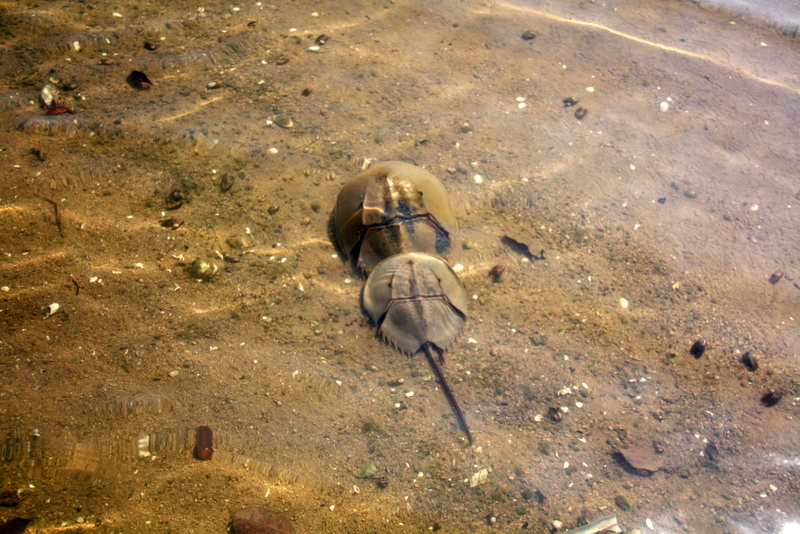
Juvenile Carcinoscorpius rotundicauda at Yi O, Lantau on 10 April 2013

Subject: Juvenile Mangrove horseshoe crabs (Carcinoscorpius rotundicauda) foraging at the inter-tidal mudflat at Yi O, Lantau, Hong Kong on 10 April 2013

Time: 1400 – 1600 hours (2 – 4 pm)

Date: 10 April 2013

Location: Inter-tidal mudflat fringed by mangroves, Yi O, Lantau, Hong Kong.


Stream fringed by mangroves. 


Inter-tidal mudflat in front of mangroves stands.


Juvenile Carcinoscorpius rotundicauda (Top picture foraging) .


Juvenile Carcinoscorpius rotundicauda (Top picture foraging).


Juvenile Carcinoscorpius rotundicauda (Top picture foraging).


Juvenile Carcinoscorpius rotundicauda (Top picture foraging).

Tuesday, 3 July 2012

Carcinoscorpius rotundicauda. Tung Chung, Hong Kong on 3 July 2012.

The following photographs are of one foraging juvenile and two mating pairs of  Carcinoscorpius rotundicauda (Mangrove horseshoe crab) photographed in a stream at Tung Chung, Lantau, Hong Kong on 3 July 2012:


Tuesday, 19 June 2012

Carcinoscorpius rotundicauda. San Tau, Hong Kong on 19 September 2010.

The following photographs are of a female Carcinoscorpius rotundicauda (Mangrove horseshoe crab) which was entangled and abandoned in a monofilament fishing net at San Tau, Lantau, Hong Kong on 19 September 2010.

This horseshoe crab, which was still alive was cut free and released back to the sea.


Saturday, 16 June 2012

Carcinoscorpius rotundicauda. Tung Chung, Hong Kong on 23 September 2010.

The following photographs are of dead Carcinoscorpius rotundicauda (Mangrove horseshoe crab) found alongside a stream which runs across the mudflat at Tung Chung, Lantau, Hong Kong on 23 September 2010.

The horseshoe crabs hanging in the mangrove bush are a male and female, possibly a mating pair which were swimming up the stream to spawn in the mangroves that line the stream. The animal lying on its back is a dead female C.  rotundicauda.

Streams are critical to the ecology of C. rotundicauda, because they use stream courses to navigate across beaches to reach the mangrove stands where they spawn. C. rotundicauda has also been observed to spawn in the lower reaches of streams in Hong Kong.


Carcinoscorpius rotundicauda. Tung Chung, Hong Kong on 6 May 2011.

The following photographs are of a male Carcinoscorpius rotundicauda (Mangrove horseshoe crab) which was caught by a fisherman in the Tung Chung stream, Lantau, Hong Kong on 6 May 2011.

A monofilament fishing net, which is similar to the one that was used to catch this horseshoe crab can be seen stretched across the stream in the first photograph.


Carcinoscorpius rotundicauda. Ha Pak Nai, Hong Kong on 19 August 2009.

The following photographs show a spawning pair of Carcinoscorpius rotundicauda (Mangrove horseshoe crab), in the muddy bank of a stream at Ha Pak Nai, Deep Bay, Hong Kong on 19 August 2009.

The male is visible in the picture. The female is buried above him in the bank of the stream.


Carcinoscorpius rotundicauda. Ha Pak Nai, Hong Kong on 1 August 2009.

The following photographs show a mating pair of Carcinoscorpius rotundicauda (Mangrove horseshoe crab), crossing a beach along the course of a stream at Ha Pak Nai, Deep Bay, Hong Kong on 1 August 2009:


Sunday, 10 June 2012

Carcinoscorpius rotundicauda. Tai Ho Wan, Hong Kong on 7 June 2012.

The following photographs show a mating pair of the horseshoe crab Carcinoscorpius rotundicauda swimming in a stream near the mouth of the Tai Ho Stream, Lantau, Hong Kong on 7 June 2012.

Undisturbed streams, particularly in their lower reaches are critical to horseshoe crab ecology in Hong Kong, because horseshoe crabs use stream courses to navigate across beaches and both T. tridentatus and C. rotundicauda  have been observed to spawn in the lower reaches of streams in Hong Kong.